The Unspoken Skill: Mastering the Art of Conversation with a London Companion
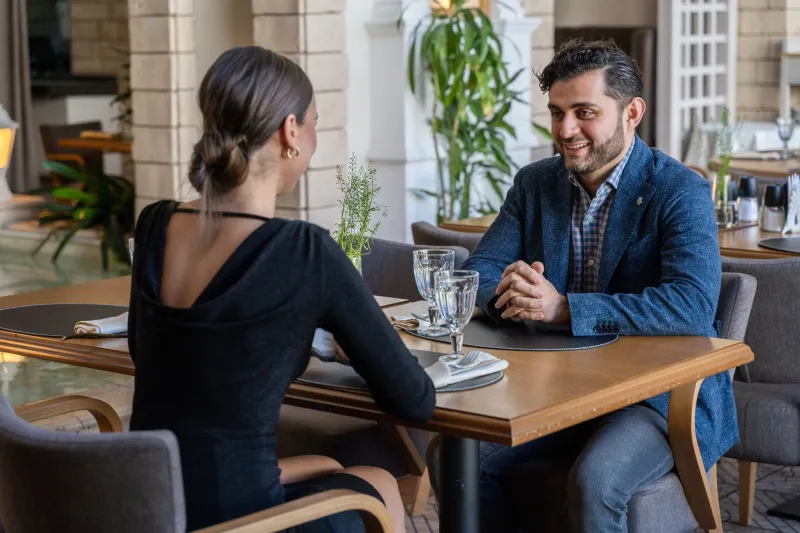
There is a particular kind of confidence that has nothing to do with appearance, wealth, or status. It is the quiet assurance of a man who knows how to hold a conversation — who listens as attentively as he speaks, who asks the right question at precisely the right moment, and who makes the person opposite him feel genuinely seen. In the context of a companionship encounter, this quality is rarer than one might expect, and far more attractive than most gentlemen realise.
The mechanics of booking are straightforward. The logistics of an evening in London — the venue, the timing, the presentation — can all be researched and arranged in advance. But the conversation? That cannot be scripted. And for many, it is precisely this unstructured element that provokes the most anxiety.
This guide is an honest, practical exploration of how to approach dialogue during a companionship encounter — not as a performance, but as a genuine exchange between two people sharing time together.
Why Conversation Matters More Than You Think
Professional companions in London are, by and large, exceptionally well-read, widely travelled, and socially perceptive individuals. They spend considerable time in the company of diverse clientele, navigating varied social environments with ease. When a gentleman arrives with genuine curiosity and the ability to hold an engaging exchange, it elevates the entire encounter — not merely for his benefit, but for hers as well.
Conversation is the connective tissue of any shared experience. It determines the pace of an evening, establishes comfort, and creates the conditions in which genuine warmth can develop. A dinner at one of Mayfair's finest restaurants, or an evening at a private members' club in St James's, is only as refined as the exchange that accompanies it.
Releasing the Pressure to Perform
One of the most common pitfalls is approaching conversation as though it were an audition — as though one must be consistently witty, impressively knowledgeable, or perpetually entertaining. This pressure is both exhausting and counterproductive. It produces exactly the stilted, self-conscious dialogue that one is hoping to avoid.
The first step, then, is permission. Permission to be imperfect. Permission to pause. Permission to say, simply, "I'm not sure — what do you think?" Authenticity is disarming in the best possible sense. A companion who has spent an evening with a man who was genuinely himself — curious, present, occasionally uncertain — will remember him far more fondly than one who delivered a polished but hollow performance.
Release the expectation of brilliance, and the conversation will breathe.
Topics That Open Rather Than Close
Not all subjects are created equal when it comes to generating natural, flowing dialogue. The most productive conversations tend to begin with open-ended territory — areas that invite reflection rather than simple yes or no responses.
Travel and place are perennially fertile ground. London itself offers an inexhaustible starting point — its neighbourhoods, its contradictions, its capacity to reinvent itself whilst remaining stubbornly itself. Asking a companion about her favourite corners of the city, or places she has visited that stayed with her, tends to produce rich, personal responses.
Culture and experience — theatre, art, food, literature — offer another avenue, particularly in a city as culturally dense as London. Rather than asking whether someone enjoys the theatre, consider asking what the last performance was that genuinely moved them, and why. The specificity invites depth.
Ideas and perspectives — current affairs handled lightly, philosophical questions approached with humour, observations about human nature — can produce some of the most unexpectedly engaging exchanges, provided they are offered as invitations rather than lectures.
What to avoid is equally important. Deeply personal interrogation — particularly regarding a companion's private life, background, or professional circumstances — is neither appropriate nor conducive to relaxed conversation. Treat the encounter as you would any sophisticated social engagement: with curiosity, but also with tact.
The Underrated Power of Listening
Perhaps the single most transformative conversational skill is one that requires no words at all. Listening — genuine, unhurried, attentive listening — is extraordinary in its rarity and its effect.
Most people, in most conversations, are not truly listening. They are waiting. Waiting for a pause in which to insert their next thought, their next anecdote, their next demonstration of relevance. A gentleman who actually hears what is being said — who follows a thread, who remembers a detail mentioned earlier in the evening and returns to it — creates an experience of being genuinely valued.
This is not a technique. It cannot be faked convincingly. But it can be practised, and the practice begins with a simple discipline: when your companion is speaking, let her finish. Resist the impulse to complete her sentences or redirect the conversation prematurely. Be curious about where her thought is going, rather than where you intend to take it.
Navigating Silence Without Anxiety
Silence, in the context of a shared evening, is not failure. Between two people who are genuinely at ease, a comfortable pause is a sign of connection rather than its absence. The instinct to fill every quiet moment with words often produces the very awkwardness one is attempting to avoid.
If a natural lull arises, allow it to settle for a moment before responding. A gentle observation about your surroundings — the room, the food, the evening unfolding outside — can re-engage conversation without the forced quality of someone scrambling to fill space. Alternatively, returning to something said earlier in the evening with a follow-up question demonstrates that you were listening, and that you are interested.
Bringing Yourself to the Exchange
Finally, and perhaps most essentially: bring something of yourself. Not a rehearsed biography, not a curated highlight reel, but genuine perspective. Share something you find fascinating, something you are uncertain about, something that surprised you recently. Vulnerability — deployed with appropriate lightness — is one of the most compelling qualities in conversation.
A companion who encounters a man willing to express genuine enthusiasm for something, or to admit a genuine curiosity about the world, is in the presence of someone worth knowing. That quality — intellectual openness, authentic engagement — is what transforms an evening from a transaction into something that both parties will recall with genuine warmth.
The booking confirms the appointment. The conversation creates the memory. Invest in it accordingly.